Having been more reliant than ever on digital, online, and social technologies over the last few months, I’ve found myself valuing the ‘offline’ experiences more and more. I know I’m not alone – many people have discovered that online life, while rich and filled with valuable experiences, cannot compare to genuine face to face communication. Zoom call fatigue is a real thing, and friends and family, having spent all day texting, emailing, and video calling, are too drained to have yet another round of online communication to catch up in the evening. Where we once would have been able to go grab a drink or have dinner, we are limited to our screens and images to communicate.
As a content marketer, my entire business is based in online spaces. I use a lot of digital technology to enable my business and clients to succeed – and it’s great, I love it and I feel very grateful that I have this ability to work from anywhere, unlimited by physical space with my work or clients. I wouldn’t have anywhere near as much freedom without digital technologies. But what I’m really interested in of late, is the post digital.
What is Post Digital?
It sounds like a backwards statement. Digital still feels so new to us, how can we already be “post” digital? Post means after doesn’t it?
Technically, yes. Post has traditionally been used as a prefix to mean ‘after’ or ‘later’. But just as with postfeminism and post-modernism (both of which are still thriving and evolving), we don’t need to take the phrase post digital as literally as meaning ‘after digital’.
Post digital means that we are now living in a world where digital technology is no longer new or emerging – it is instead a totally accepted part of everyday life and we have adapted our lives to include it. As a result of digital technology now being commonplace, there is a reaction to bring digital technologies back to the people that use them – the humanisation of digital technology and experiences.
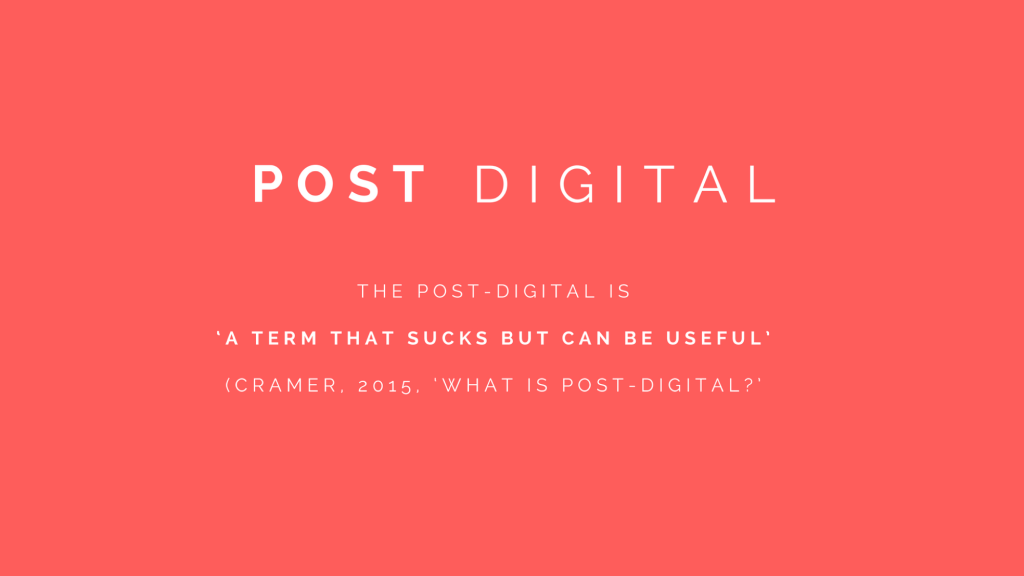
Post digital is an attitude that is more concerned with being human than being digital. Giorgio Agamben, Mel Alexenberg, Roy Ascott, and Florian Cramer all discuss post digital from an artistic and media theory perspective and have wide ranging takes on the subject with interesting angles and arguments. Cramer in particular has some great insight into post digital, including his famous quote:
Living in a Post Digital World
I like to think of post digital as being a way of blending online and offline experiences. AR technology is a great example of this. Pokemon Go and SnapChat filters are ways of mixing our online experiences with the offline. A good way of understanding this is not through a literal physicality but more of an elicited emotional response.
Video games are an excellent example of post digital experience – my MA work covered this in detail using World of Warcraft. We are highly embodied and emotional when playing games – tensing up during fight scenes, getting frustrated at failure, celebrating a win or mourning a character death. We may play online, communicating with players around the world and even get together to play in the same space. We blend our offline bodies and emotions with our online use of digital technology – making it a great example of how we use post digital in ways we take for granted.
The post digital world is more aware of how emotions function in people and how these are understood and acted upon. The use of emojis as commonplace in communication demonstrates that we are keen to show our emotions even when we are not face-to-face – we still crave that understanding of body language and genuine expression. We want to use technology to enhance our human experience, rather than limit or alter it totally to a state where we struggle to interact in ways that are familiar to us. David Sable discusses the idea of digital exponential which is a really insightful take on emerging digital and post digital interactions.
Post Digital in Business and Marketing
Businesses have been catching on to the use of post digital practices for a few years now. With increased online shopping and decreased high street footfall, businesses and marketers have had to get creative to drive people to buy through creating personalised experiences for them. This goes beyond targeted advertising – it’s about people being able to feel noticed and ‘special’ when interacting with businesses.
The rise of personalised subscription boxes is a post digital trend – you can get pretty much anything on monthly subscription, from houseplants to gin to candles and even your weekly food shop. These products are personalised online, either by the customer initially and then usually through an algorithm that learns your likes and tastes to send you products that match. This type of service therefore becomes highly personal, and with the physical delivery aspect (the excitement of a present), this is a post digital experience. Sign up online, answer some questions so a company can learn who you are and what you like, receive useful and tailored products and services for you.
People want to feel valued as customers. This isn’t new in marketing – advertisement campaigns have worked for decades to create feelings of value and specialness within customers to encourage purchases. The difficulty marketers face now is that customers aren’t necessarily where they used to be, and expectations are higher than ever to deliver these types of unique and tailored experiences.
Post digital practice in businesses needs to tread a fine line between delivering business profits and sales, while creating an experience for the customer where they feel valued and included. The difficulty most businesses have is finding the balance without it looking like lip service to current trends. It’s also deciding if this kind of personalised approach fits with your business model. While there’s no harm in experimenting, your target audience might be more straightforward and want to cut through the emotional fluff of a personalised, tailored experience and instead get the products and services they need quickly.
It’s likely that post digital experiences and the post digital world will continue to evolve over the coming years as we adapt to new forms of technology and marketers find ways of creating new experiences . This is something that will become increasingly important in a socially distanced world where traditional staples like trade shows and exhibitions will be severely limited, if not gone entirely, for the time being. By understanding what audiences want from their technology, products and services, the post digital world will continue to evolve in line with our needs and wants, creating an exciting blended future of online and offline, emotional and embodied experiences.
 H.J.Albone Media