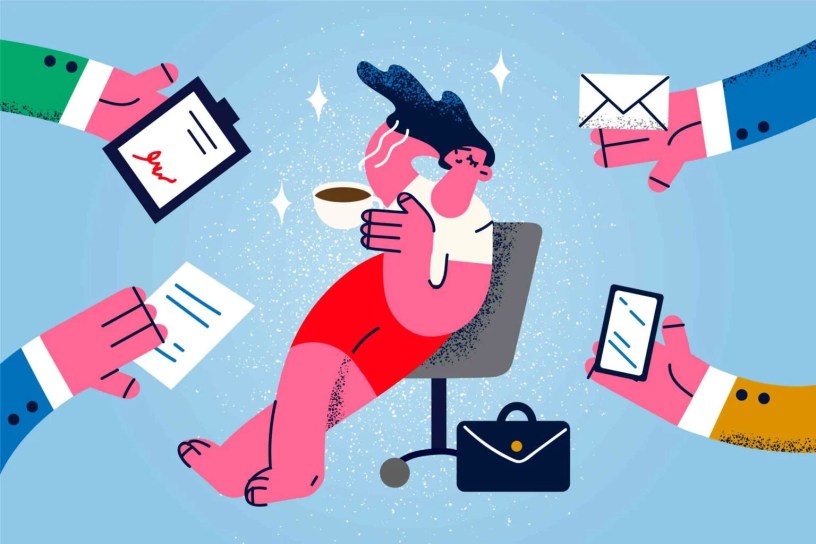
I can distinctly remember being at school and learning about best practices for exam revision. What I remember most was the rule of revising for a maximum of 40 minutes on one topic or subject. Then we were advised to take a break – either switching off or doing some speed testing/quick pace quizzing for the remaining 20 minutes.
Whether it’s true that the brain (or at least, the brains of 16 year olds) can only concentrate in full for a maximum of 40 minutes is debatable. But it does show that building in breaks and using them to your advantage is important.
A lot of office work has similarities to school learning. We sit at desks, absorb information, demonstrate our learning/skill/expertise in applications, and present it back to seniors for review and approval. So how come concentration is expected to happen for 8 hour stretches now?
It’s well-documented that taking breaks is essential for things like creativity and problem-solving. Letting your brain rest from intense processing can in fact lead you right to the answer. However, as anyone who has been grappling with a particularly tricky problem or project will tell you, simply walking away from your desk doesn’t necessarily mean walking away from the issue. You need to actively redirect your brain and thought pattern to temporarily stop thinking about it.
These kinds of diversion tactics are popular with people who struggle with things like anxiety, depression, PTSD and more, allowing you to pivot away from the oncoming issue as you feel it creeping up on you. By giving the brain something different to focus on, it’s easy to put other things in the background.
Mini Break – up to 15 minutes
For a quick break, something like Tetris or Solitaire is good. It requires a lot of focus and concentration, and you can play for 5 minutes or 15. Leaving the desk and changing rooms is helpful too. If possible, switch up your work setting completely. But blasting three dance anthems or bubblegum pop songs for a dance break in the kitchen can also be a great brain shake-up. Sounds ridiculous but honestly, just try it. Opt for super catchy songs that are easy to move to – see Taylor Swift or Lizzo for inspiration.
You can try something sensory too if that helps. Sometimes a sensory shock can help realign the brains when we’re in a rut. Eat something super minty or super sour like lemon to give your senses a surprise that shakes things up.
Medium break – up to 30 minutes
You can still apply all of the above to medium breaks, but if you have the chance definitely leave your desk. Leave your phone as well! Get outside, open a window, maybe even wash your face or take a super quick shower to reset yourself. A friend of mine swears by exercising on a lunch break as a great way to shake off any morning funk. This sounds like actual hell to me as I get way too sweaty for this to be a feasible option, but to each their own. Even doing quick household chores can be a good brain switch-off. Play an instrument? Grab it for 20 minutes and play some loose riffs or a piece you know well.
The aim of the game here is to redirect your brain away from its stuck pattern of processing and thinking. By breaking a cycle you can actually allow yourself more opportunity to access the creative parts of your brain that are needed for overcoming that current challenge.
Productivity Spiral
It’s very easy to get caught up in the productivity doom spiral. Capitalism teaches us that time spent not working is unproductive, unprofitable and therefore not worthy or useful. If you are timesheeted at your workplace and measured on chargeable/non-chargeable time this becomes considerably more stressful as data shows when you’re not making money for the business. But ironically, the harder you work and the more you push yourself with minimal breaks or downtime, the quicker you’ll hit the wall of burnout where time off is the only option for a reset.
Creative pursuits especially require the chance to pause, reflect and breathe in order to deliver their best results. The slogan ‘Beanz meanz Heinz’ took three months to be fully realised, and when it was written down, the advertising team were eating sandwiches in a pub. The team who devised this in 1967 took the time to properly process and think about it before they reached the final version – resulting in a winning line that is still used today.
Although a deeply unhealthy habit, smoke breaks are a classic way of adding a quick break to your day. Objectively, they hit the brief: stepping away from your desk, giving you a change of scenery, and a sensory moment. They act as regular ‘prescribed pauses’ in a working day, giving you time to process and absorb. I smoked casually during my third year of university exactly for this reason; it gave me an excuse to go outside and take a break from my studies. Swedish working culture has a similar practice called ‘fika’, where employees take a break in the morning and afternoon to pause, speak to colleagues, drink coffee, and get some time away from screens.
So go ahead and take that break when you need it. It won’t derail your day – in fact, it might even help you get back on track.
 H.J.Albone Media