“Write without fear, edit without mercy.” This popular phrase pops up all over writing inspo social media sites, and it certainly strikes true for those working in fiction writing or more opinion-based pieces. It strikes less of a chord when you put it into the context of writing press releases or somewhat dry technical information. I’ve never written without fear about fire alarm installation or ductwork maintenance for example.
NaNoWriMo is a perfect way to learn how to write without fear. You don’t have time to agonise over plot holes, repeated phrases, or clumsy dialogue. Your word count for the day is looming! Working for a press office will also get your typing speed up. Deadlines can be insanely tight (maybe 2 hours at times to turn something around for issue to the press) so you’ve got to write, commit, and be accurate.
However, as a person who has both done NaNoWriMo and worked in busy press offices, you learn that writing without fear doesn’t mean what you write is good. In fact, first drafts are 99% bad. Really really bad. Terry Pratchett summed this up eloquently:
The first draft is the first of many steps. Don’t fret if a scene isn’t working, or if a part of your book isn’t what you imagined. You’re just telling yourself the story to the best of your ability. You will have plenty of time during revisions to shape the book into what you want it to be.
Terry Pratchett
If, like me, you spend a lot of time working with creative, talented people, and reading books by smart, wonderful writers in your free time, it can be easy to assume everything you write will never be good enough. You will always fall sub-par and what you write might just scrape the regions of ‘okay’.
But as with everything in life, the only way to improve things is to practise. And that means writing bad stuff, writing boring stuff, writing headlines and dialogue that make you cringe. There are plenty of successful writers out there who are not good at writing. There are plenty of unsuccessful writers who are sheer brilliance. The difference tends to come down to luck, bravery, and a bit more luck. Note: here I am defining success as commercial success, such as a published book deal.
I keep everything I write. All my first drafts, and all my finished pieces. I have a whole folder of poetry on my computer that dates back to my early teens. I have at least three half-finished novels that I worked on variously throughout my teens. I have scripts, plots, character profiles, maps, lore and more which will likely never come to light in any form.
So why keep them?
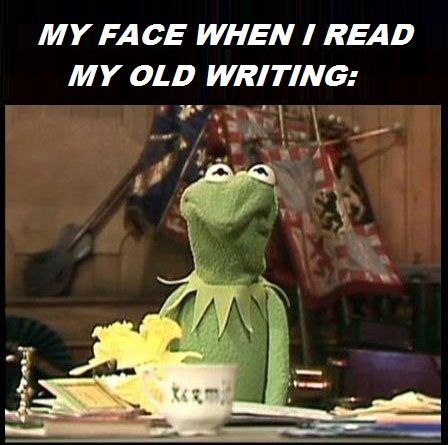
It’s about seeing the progress. Every bad poem has led me to being a more confident writer with a more defined tone of voice. Every half-baked novel that languishes on my hard drive has taught me that plotting is important and perseverance even more so. Reading back over them is like my own personal writing history. I can see the flair and the seeds of ideas, but were perhaps hamstrung by my own lack of development, or overly influenced by the type of novels I was reading at the time.
At times it feels a little like reading a stranger’s work, but then I see a turn of phrase or a stylistic choice and I can see an echo of my younger self. I can picture myself sitting at the clunky CRT monitor computer I had in my room (it had no internet connection, it was purely for typing and playing some games), typing away at the massive keyboard. Or else I see myself hiding away in the school library, furiously writing in a free period. Go back further and I’m cross-legged on the floor with an A4 spiralbound notebook, writing stories about fairies and snowmen and beanie babies.
In a way, I like seeing the bad stuff – because it’s not bad. Not everything you ever do will be a masterpiece or portfolio-worthy. All pieces serve a purpose. You learn from them, refine your technique, experiment with styles, read better authors, work with other writers. Sometimes a finished piece is just ‘fine’. Learning that it’s okay to have pieces that aren’t award-winners helps you recognise when the really good stuff comes along. When it’s all clicking and flowing and you’ve written something so damn good you want to pat yourself on the back and you can’t wait to share it. Take time to remember every shitty teenage poem or garbled essay that led you here. The road to good writing is paved with a thousand pages of bad writing.
So get writing! And don’t be afraid if it’s no good. The backspace key exists for a reason – and practise really does make perfect.
 H.J.Albone Media
I like to write in terror and edit blind drunk. And then edit again when the hangover subsides.
LikeLike